
How to Choose Functional Masterbatches for EPE Foam: Talc, Antistatic, Flame-Retardant and Color
Introduction
A functional masterbatch is not simply “an additive in pellet form.” It is a concentrated system in which one or more functional components are dispersed in a polymer carrier so they can be metered into a production formulation. In EPE foam extrusion, a masterbatch may support nucleation, introduce color, modify electrical behavior, or help a finished product work toward a specified flame test.
The purchasing difficulty is that these functions are evaluated in different ways. A talc masterbatch is judged partly through feeding, dispersion and cell structure. A color masterbatch is judged through an agreed visual or instrumental color standard. An antistatic masterbatch requires a clearly defined electrical and service-life objective. A flame-retardant masterbatch must be connected to the correct finished-product test method and specimen.
For all four categories, the masterbatch datasheet is only the beginning. Carrier compatibility, concentration, dispersion, process conditions, the base resin and the finished-foam test determine whether a grade is suitable.
Short answer: Choose an EPE foam masterbatch by first defining the finished-product function, then confirming carrier resin, concentration, dispersion, documentation and a controlled trial plan. Do not approve a grade from color, a generic dosage, or a masterbatch certificate alone. Test the representative finished foam under the conditions that matter to the application.
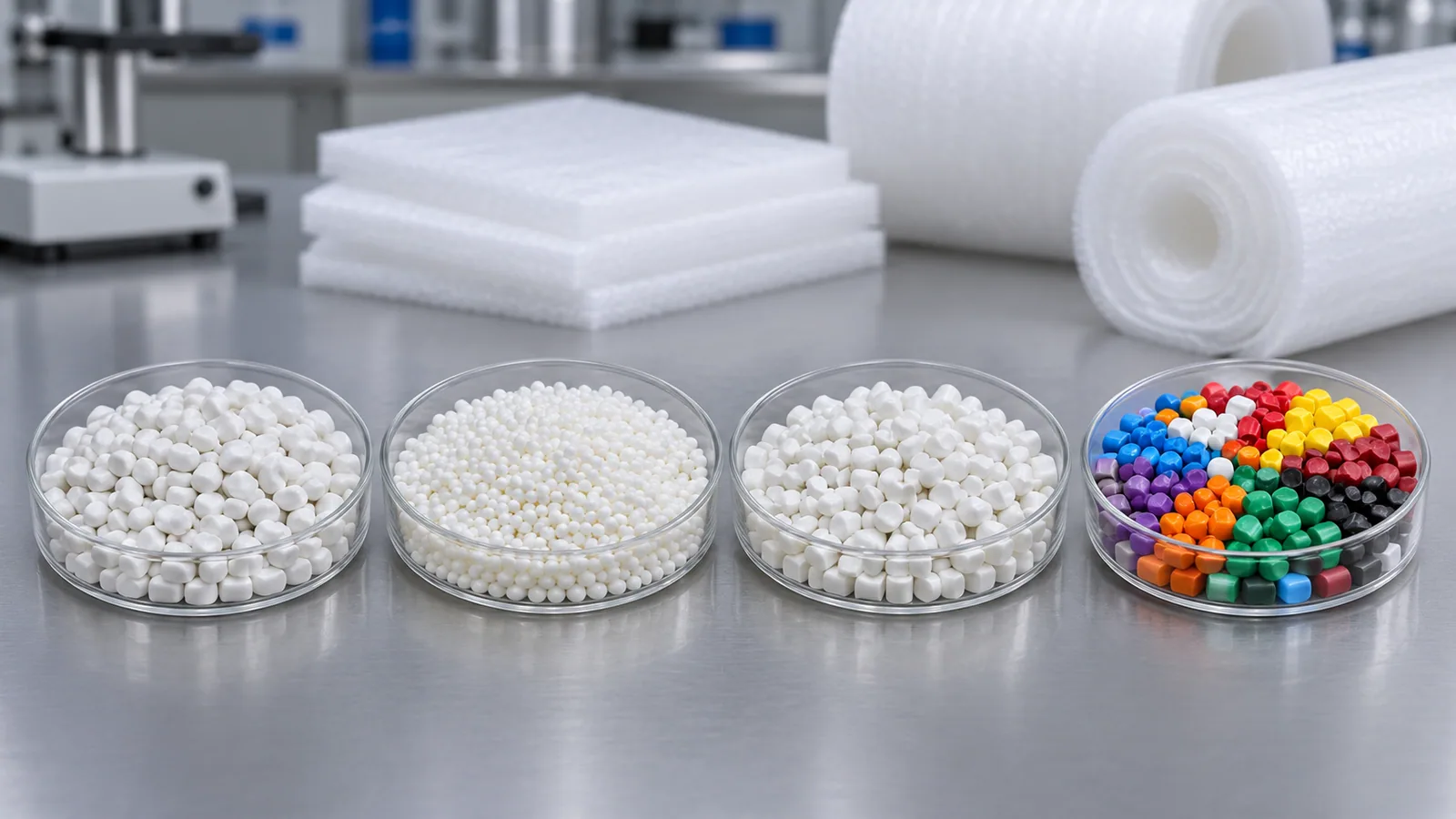
What a masterbatch changes—and what it cannot prove
A masterbatch can make a functional ingredient easier to handle and meter than a loose powder or liquid. It may improve distribution when the carrier and compounding quality are suitable. It can also simplify material identification and housekeeping.
However, a masterbatch adds more than the headline active ingredient. It also adds a carrier resin and may include dispersing or processing aids. Those components enter the EPE formulation and can influence flow, cell formation, surface, odor, color, mechanical response, or downstream conversion.
The supplier can describe the grade and provide technical or batch information. The buyer still has to establish whether the complete formulation produces the required foam on the intended line.
Use five questions for every category:
- What finished-product function is required?
- How will that function be measured?
- Is the carrier compatible with the base resin and process?
- What evidence identifies the sample and commercial shipment?
- What controlled factory trial will support approval?
A practical comparison of four EPE masterbatch types
| Masterbatch type | Primary purchasing question | Finished-foam evidence to review | Common approval mistake |
|---|---|---|---|
| Talc foaming masterbatch | Does it support the required cell structure and stable feeding in this formulation? | Cell distribution, surface, dimensions, output, scrap and conversion behavior | Buying by talc percentage alone |
| Antistatic masterbatch | Which electrical function, test method, environment and service period are required? | Conditioned finished-foam and, where relevant, assembled-package test | Treating pink color or one resistance value as proof |
| Flame-retardant masterbatch | Which exact finished-product flammability classification applies? | Representative specimen tested to the agreed method and thickness | Assuming an additive claim transfers to finished foam |
| Color masterbatch | What color standard and viewing conditions define acceptance? | Representative finished foam under agreed lighting or instrument method | Approving from a screen image or pellet color |
Talc foaming masterbatch: focus on nucleation and dispersion
Talc can function as a nucleating aid in suitable polyolefin foam formulations. Nucleation influences where gas cells begin to form. The production result therefore depends on more than mineral content: particle characteristics, distribution, carrier resin, feeding and the process window all matter.
What to request from the supplier
Ask for the exact grade, carrier resin, stated mineral or active content, relevant particle or dispersion information, pellet appearance, storage guidance, safety data, technical data and the type of batch document available. If the supplier provides a starting addition range, treat it as a trial reference rather than a guaranteed recipe.
The carrier deserves explicit attention. A carrier that is broadly described as “PE” may still differ from the buyer’s base resin in flow or additive package. Ask what the supplier can confirm without demanding confidential formulation details.
What to observe during a factory trial
Record feeding consistency, dust or handling changes, pressure and motor-load behavior, output, surface, cell distribution, dimensions, winding and waste. Compare the result with a stable baseline using the same product target.
If cells look finer but the roll becomes less stable, conversion becomes difficult, or scrap increases, the result is not an automatic improvement. Define the priority before the trial.
Shipment inspection points
Check packaging integrity, grade and batch labels, pellet consistency, visible contamination, quantity and required documents. If ash or another compositional check is part of the agreement, define the method, sampling and acceptance rule before ordering.
Antistatic masterbatch: specify the electrical job
The word “antistatic” is often used too broadly. A buyer may need low charging, charge dissipation, conductivity, or protection from an external electrostatic discharge. These are related but distinct requirements.
The EOS/ESD Association explains that low-charging behavior is not necessarily predicted by resistance or resistivity. It also distinguishes conductive or dissipative packaging behavior from discharge shielding. This matters because a foam color, additive name, or single resistance measurement may not describe the protection needed by a sensitive device.
Build the inquiry around the handling route
Describe what is packed, its sensitivity, where packing and unpacking occur, whether the package moves inside or outside an electrostatic protected area, expected storage time, temperature and humidity, and whether the foam contacts the device directly.
Then state:
- property to measure;
- test method;
- specimen and electrode setup;
- preconditioning and test environment;
- acceptable range;
- required service period;
- whether the assembled package also needs evaluation.
If the buyer does not yet know the correct requirement, that is a reason to involve the device owner or ESD control professional before requesting a masterbatch dosage.
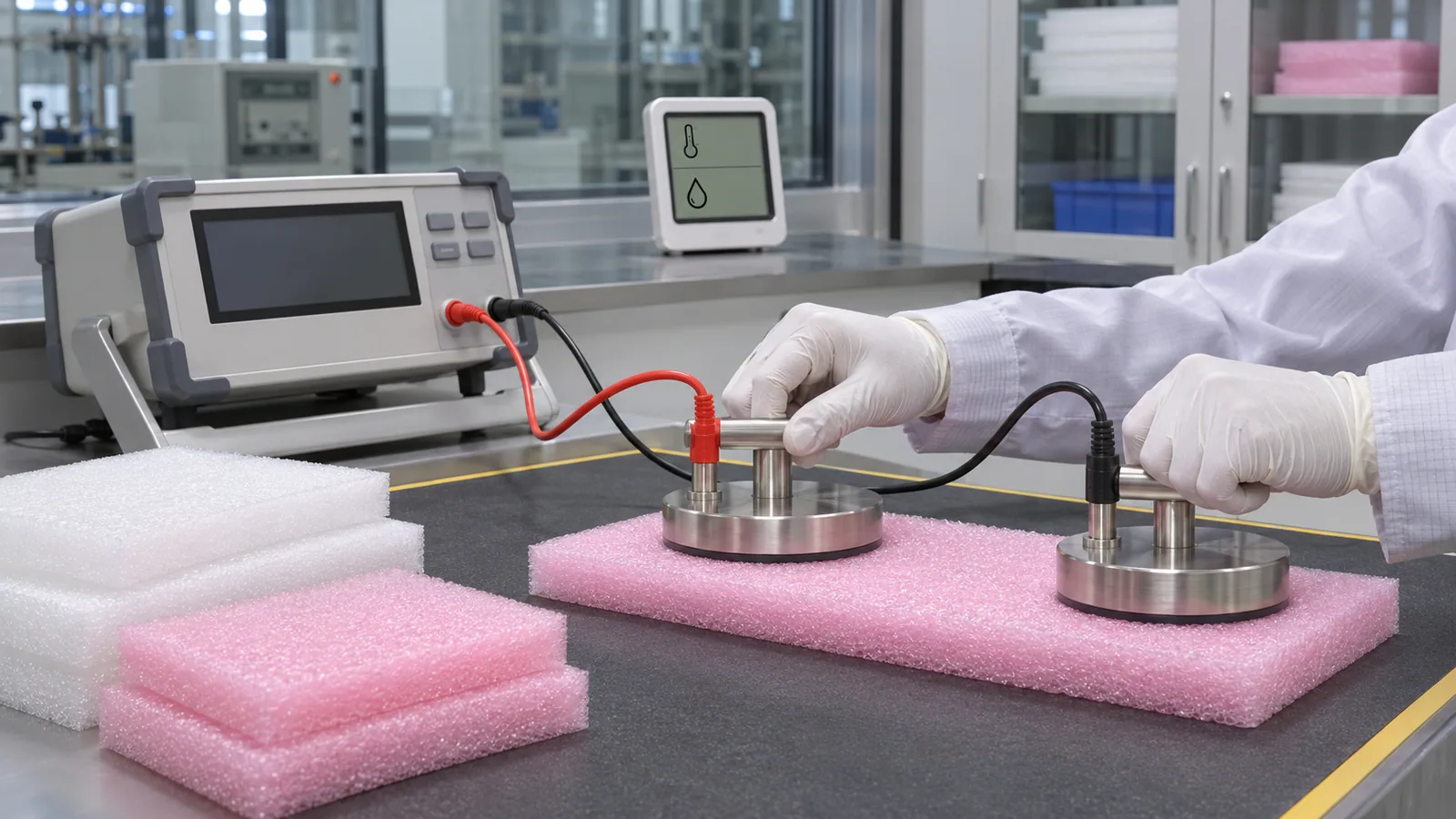
Plan for environmental and time effects
Some antistatic systems depend on the environment or may change with time, migration, storage, surface contamination, or conversion. The trial should include the relevant conditioning and aging interval, not only a measurement immediately after extrusion.
Keep compliance claims narrow
Ask for evidence tied to the exact grade. Do not turn a supplier’s raw-material statement into an unsupported claim about the finished electronics package. The converter or product owner should confirm the applicable standard and acceptance plan.
Flame-retardant masterbatch: start with the required test
“Flame retardant” is not one performance level. The applicable method may depend on the market, end product, foam density, thickness, orientation, conditioning and specimen construction.
UL Solutions describes several UL 94 classification groups and specifically identifies HBF, HF-1 and HF-2 for low-density foam materials. Other classifications apply to solid plastics or thin materials. A buyer should not ask only for “V-0 masterbatch” and assume that a finished EPE foam automatically earns a V-0 classification.
Information to settle before grade selection
- target market and end use;
- governing customer, regulatory, or certification requirement;
- exact standard and classification;
- specimen thickness, density and construction;
- conditioning and test laboratory requirements;
- limitations on halogens, substances, smoke, odor, color, or mechanical properties;
- whether the result applies to raw foam, laminate, converted part, or complete assembly.
Trial and test sequence
Begin with a processability trial: feeding, dispersion, extrusion stability, cell structure, surface and mechanical response. Produce representative specimens using documented materials and conditions. Submit the correct specimens to the agreed qualified laboratory or customer test route.
An internal flame observation can help screen a formulation, but it should not be represented as certification. Preserve sample identity and the formulation record that connects the tested specimen to future production.
Commercial implications
Flame-retardant systems may affect cost, density, color, odor, cell structure, mechanical performance or recycling practices. Evaluate the complete acceptance window rather than maximizing additive loading.
Color masterbatch: approve color in foam, not on a screen
A color masterbatch combines pigment or dye with a carrier system. Its suitability depends on more than whether the pellets look close to a requested color.
Foam density, thickness, cell structure, surface texture, base-resin color, other additives and lighting can change the visual result. A digital image is also affected by camera exposure, white balance, display calibration and compression.
Define the color target
Use a physical approved sample or an agreed color-system reference when practical. State whether the product is opaque, translucent, light or dark, and whether color is evaluated on a cut surface, skin surface, roll, sheet or converted part.
For instrumental control, agree on the instrument geometry, illuminant, observer, sample preparation and color-difference calculation. A Delta E limit without the measurement setup is incomplete.
Evaluate more than shade
Inspect dispersion, streaks, specks, plate-out, migration, rub-off, heat stability, odor and the effect on foam structure or downstream bonding and printing. For a food, toy, medical, automotive or other regulated application, ask the product owner which substance and documentation requirements apply. Do not infer compliance from the color name.
Control the approved reference
Keep the approved physical sample protected from light, heat and contamination. Record the masterbatch grade, dosage used in the approved trial, base resin, foam condition and date. If the supplier changes pigment source or formulation, the buyer may need requalification.
Compare carrier resin and concentration correctly
Two masterbatches offered for the same function may contain different active levels. A lower price per kilogram does not mean a lower use cost, and a higher concentration does not guarantee easier processing or better performance.
Compare:
- active or functional component information available;
- carrier type and compatibility;
- recommended trial range;
- dispersion quality and pellet consistency;
- required addition equipment and feeding accuracy;
- effect on base-resin balance;
- accepted output per kilogram of finished foam;
- scrap, cleaning and changeover implications;
- documentation and batch controls.
Calculate the material cost at the trialed addition level, then relate it to accepted production output. Include the cost of rejected rolls, line time, testing and customer approval.
Design a controlled masterbatch trial

1. Write the decision statement
Examples:
- Approve or reject a talc masterbatch for the current white EPE roll within the defined density range.
- Identify an antistatic formulation that meets the agreed conditioned finished-foam measurement.
- Produce specimens for the specified foam flammability test without unacceptable extrusion defects.
- Match the approved blue foam sample within the agreed visual and instrumental conditions.
2. Lock the baseline
Record the current resin, additives, material batches, product dimensions, density, line settings, environment, output and accepted quality. Keep one representative baseline sample.
3. Control variables
Change one primary factor at a time where practical. Use calibrated feeding equipment suitable for the addition level. Allow the line to clear the previous formulation and reach a stable condition.
4. Collect timed samples
Label samples with formulation, time and line condition. Retain enough material for immediate inspection, delayed checks, conversion trials and external testing.
5. Assess the complete result
Review the target function plus cell structure, density, dimensions, surface, odor, color, mechanical behavior, output, scrap and downstream processing. A formulation that meets one number but fails the product is not approved.
6. Document approval boundaries
State the product, line, grade, addition level, operating range, test method, document revision and restrictions. Define which future changes require notice or re-trial.
Mid-article CTA: Ask for a Grade Review
Choosing between talc, antistatic, flame-retardant and color masterbatches begins with the required finished-foam result. Send FULL TECH your base resin, product, target function, current issue, trial quantity and destination. We can help organize the questions for a grade and document review.
Supplier documents and trust signals
The document package should be proportional to the decision and market. Common items include a technical data sheet, safety data sheet, product identification, batch document, packaging specification and relevant compliance statements available for the exact grade.
Review the revision date and scope. A document for a different grade, carrier, manufacturing site or region may not support the proposed shipment. If a statement relies on third-party testing, confirm the specimen, method, result, laboratory and whether the report can legitimately be applied to the supplied grade.
Trust also depends on how the supplier handles uncertainty. A credible supplier should distinguish typical data from guaranteed specifications, masterbatch data from finished-product performance, and a suggested trial range from an approved formula.
Receiving and shipment inspection
Before shipment, an agreed inspection can confirm:
- product and grade name;
- batch or lot numbers;
- packaging type, count and net weight;
- label and shipping-mark accuracy;
- pallet and bag condition;
- visible pellet consistency and contamination checks where appropriate;
- required document set;
- container condition and loading record.
On receipt, check for water exposure, damaged bags, missing labels or contamination before releasing material to production. Match the shipment to the purchase order and approved grade. Store it according to the current supplier guidance, and use lot control so a production issue can be traced.

Frequently Asked Questions
What is the best masterbatch for EPE foam?
There is no universal best grade. The correct choice depends on the required function, base resin, line, product, test method, market and commercial constraints. Approve it through a controlled trial and representative finished-foam evaluation.
Is talc powder the same as talc masterbatch?
No. A talc masterbatch contains talc dispersed in a polymer carrier and may change handling and feeding compared with loose powder. Carrier compatibility and concentration must be included in the formulation review.
Does pink EPE foam prove antistatic performance?
No. Pink is a visual convention, not an electrical test result. Specify the required property, method, conditioning, range and service period, then test the finished foam and package as needed.
Can a flame-retardant masterbatch guarantee a UL 94 rating?
No. A finished-product classification depends on the complete formulation, foam specimen, thickness, density, conditioning and test method. Use the correct qualified test route for representative specimens.
How should a color masterbatch be approved?
Approve it in representative finished foam against a physical or agreed color reference under defined lighting or instrumental conditions. Also inspect dispersion, surface and process effects.
Should I choose the highest masterbatch concentration?
Not automatically. Compare carrier compatibility, dispersion, feeding accuracy, trial addition level, accepted output, documentation and total production cost. Higher concentration can create metering or distribution challenges at low addition levels.
What should be included in a masterbatch inquiry?
Include the finished product, base resin, target function, test requirement, current grade and addition level, color or physical reference, estimated quantity, destination, packaging, regulatory context and the production problem to solve.
Conclusion
Functional masterbatch selection should begin with a measurable job in the finished EPE foam. Talc masterbatch is evaluated through nucleation, dispersion and production stability. Antistatic masterbatch requires a precise electrical and service-life definition. Flame-retardant masterbatch must be tied to the correct finished-product test. Color masterbatch must be approved in representative foam under controlled viewing or measurement conditions.
Across all four categories, the reliable workflow is the same: define the function, confirm carrier and grade identity, compare documents, run a controlled trial, evaluate the complete foam, and preserve the approved formulation through shipment and receiving controls.
Final CTA: Compare a Functional Masterbatch Option
Send FULL TECH your EPE product, base resin, required function, test or color target, current material, trial quantity and destination. We will help structure a focused request for the relevant masterbatch option and supporting documents.
Technical References
- European Patent Office, EP 2285872 B1 — examples of masterbatch design and functional additives in physically blown polyethylene foam; patent examples are not universal production instructions.
- EOS/ESD Association, Fundamentals of ESD, Part 3 — packaging functions and limitations of resistance as a predictor of low charging.
- UL Solutions, Combustion (Fire) Tests for Plastics — distinctions among UL 94 methods and classifications, including low-density foam classifications.
- ASTM International plastics resources — importance of named methods and controlled specimen conditions for material measurements.
